Why I'm doing math
I’m old. I take Calculus 2, mostly with 20-year-olds. Last semester it was Calc 1; next it will be Calc 3, and maybe Differential Equations. Why? At first it was to qualify for a graduate program and get back to a status-filled tech job. It has taken a different shape as I’ve done more of it.
A million years ago
We were sitting in the kitchen the other day and Jack was talking us through his grades. His lowest is a 94%. I facetiously asked if that was a B. It was needling, maybe uncalled for. Amy asked the kids: Do you know what would happen to Dad if he got a B? I laughed: I never found out!
In the sixth grade, slightly more than a million years ago, I used Lotus 1-2-3 to set up a statistical analysis of my basketball team. I had been programming in Basic, Visual Basic and a very little bit of C++ for a few years by then. My basketball did not improve via Lotus 1-2-3. But the spreadsheet caught a teacher's attention, and it was determined that I could handle algebra a year before my peers. I did so.
Socially, it was traumatic to be bussed to the high school to take Geometry. But I really liked the proofs, the way certain statements could be fit together, elegantly, to reach an indisputable conclusion. I took the rest of the math courses available. My senior year, a new program had been set up with a local university: a self-led Calc 2. I started strong. Then I realized there was little penalty (I thought) in cramming all the Mathematica problem sets until just before the infrequent tests. I learned little, mostly that I was not capable of being very self-led at 17. I think I received a C, likely the worst grade of my academic life to that point. I was embarrassed. I swore off math in college, at a liberal arts school, although I did enjoy a random topology course.
Later, in the intervening million years, I became employable, due mostly to luck and fortuitous bounces. The colleagues I was most drawn to could explain concepts and hunches using analysis and data. Occasionally I could help them make their stories slightly more palatable to the heathen customers or the philistine executives. There is a lot of math in the world, it turns out.
So in 2025, when I signed up for Linear Algebra, my expectation was that I would get a good grade. I am not sure I considered anything else. As the grades came out, when I realized what was happening, what my score was destined to be, a C, barely, it was very destabilizing. I wasn’t sad or anguished; it just felt like it was happening to me, like a car accident.
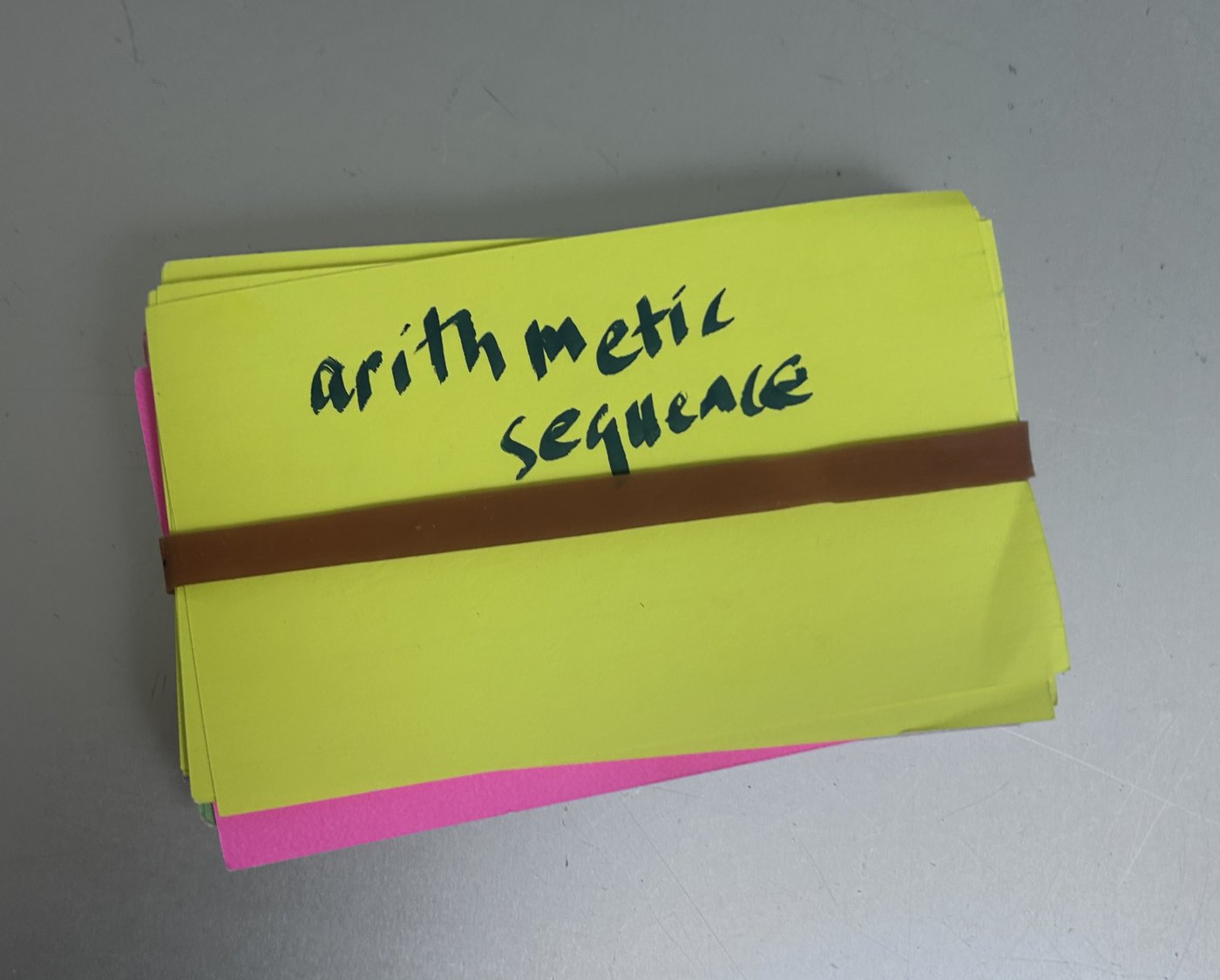
I’m taking Calc 2 now, for the second time, and it’s massively easier than the first. I’m older, and I take the work and the workload seriously. But something else is helping. There is a student, Asa, who answers every rhetorical question the professor poses (And what is the integral of cos over sin squared? Asa: cosecant, immediately). So I watch him, and I realize that before class, before every class, he drills flashcards. He has a strategy, he has a plan. I have an insistence that I was once good at math, a kind of pride. His wins. For the first time in my life, I have made flashcards. When I’m in a good process, I study them nightly. Drilling flashcards may have a performative element to it, but it’s a real tactic. It’s also an acknowledgement: I do have to study, I can’t retain this all that well. The flashcards help. I expected that once I had the flashcards I would get most of them, but there are concepts that sneak up on me, that I figure out, that I know, and then can’t answer. The derivative of log base b of x, for instance. Is that 1 over x ln b?
The pencil
Something else is happening now, mostly on exams. I was doing a trig integral, likely this one.

Halfway through, I realized I was manipulating the trig substitutions in my head, canceling as I wrote out the steps. I didn’t know I knew how to do that. I stopped and redid the line on scratch paper, to see if I could duplicate it. I could, so I kept going. The work was being done, but not necessarily by me. I had this feeling in high school, in geometry and Algebra II. The pencil wrote the answers; my conscious brain didn’t engage, and when it did, it got me in trouble. It was better to just go than to think it out.
I also really like answering questions correctly. I like when I see patterns. I like when I watch myself write an answer to a problem that I didn’t know I knew. I like the feeling of moving through work this way. I like that the limit of a function exists; it reminds me that there are many limits in my life, where I get near but not necessarily at. Unlike my life, there are correct answers. Unlike my life, there are ways of working through a proof that bring coherence, finality and QED. Not much in life feels like that.
And I’m finding some skills. I catch myself coaching myself through daunting problems: ok, you know this is a trig identity integral, what form? Ok, that last answer wasn’t great, take a deep breath, this one is easier. Or even: you need more quiet to get this work done.
Toward what
This feels slightly clearer than it did. I want to pursue graduate-level work. Math will be it, or a large part of it. I’m not sure what the exact field of study is.
And then what? Do I want to be a math professor at a community college? Some part of me likes the idea of that, although it’s not clear what I think that job actually is. Do I want a job offer from a tech or AI company? Some part of my ego wants that.
But a slightly wiser part of me wonders. I understand what tech companies do, and don’t do. The changes we are going to live through in the next few years, in math and in how computers work, will be monumental. I don’t think I have the profile of those who push those changes forward. But I’ve always been able to translate some part of the decidedly technical and arcane into something others can react to, or buy, or finance. Can I do that here too?
END